
Safer Recruitment procedures must be followed for all employees and volunteers whose role involves substantial contact with children, young people, or vulnerable adults.
These procedures are taken from the Church of England Safer Recruitment and People Management Code of Practice
WHAT ROLES FALL WITHIN THE SCOPE OF THIS CODE OF PRACTICE?
Substantial Contact
This phrase distinguishes between roles that are specifically intended to work with children or vulnerable adults and those where contact with them is incidental to the role. The examples below are roles that are likely to be covered by this code, but the list is not exhaustive. Each role should be assessed individually.
- Clergy
- Youth ministers and youth workers, whether leaders or supporters/helpers
- Sunday school teachers and helpers
- Parent Toddler leader and supporters/helpers
- Parish Safeguarding Officer or members of the Safeguarding Team
- Parish Volunteer driver for children
- Roles which involve the supervision or training of children, e.g. some Tower Captains, Music Leaders, Head Servers
- Readers; Worship Leaders; Authorised Lay Ministers; Licensed Evangelists
- Leader of a group for people with dementia, and supporters/helpers
- Those providing home (pastoral) visits/prayer ministry
Roles that would not normally be subject to Safer Recruitment Processes
- Shop staff
- Flower arrangers, gardeners, maintenance staff, cleaners
- Visitor engagement staff/Welcome team
- Choir members, bell ringers etc with no responsibility for training or supervising children
- Those helping with refreshments after services
- Sidesperson
- Church administrator
- DBF staff/Governance boards other than PCCs
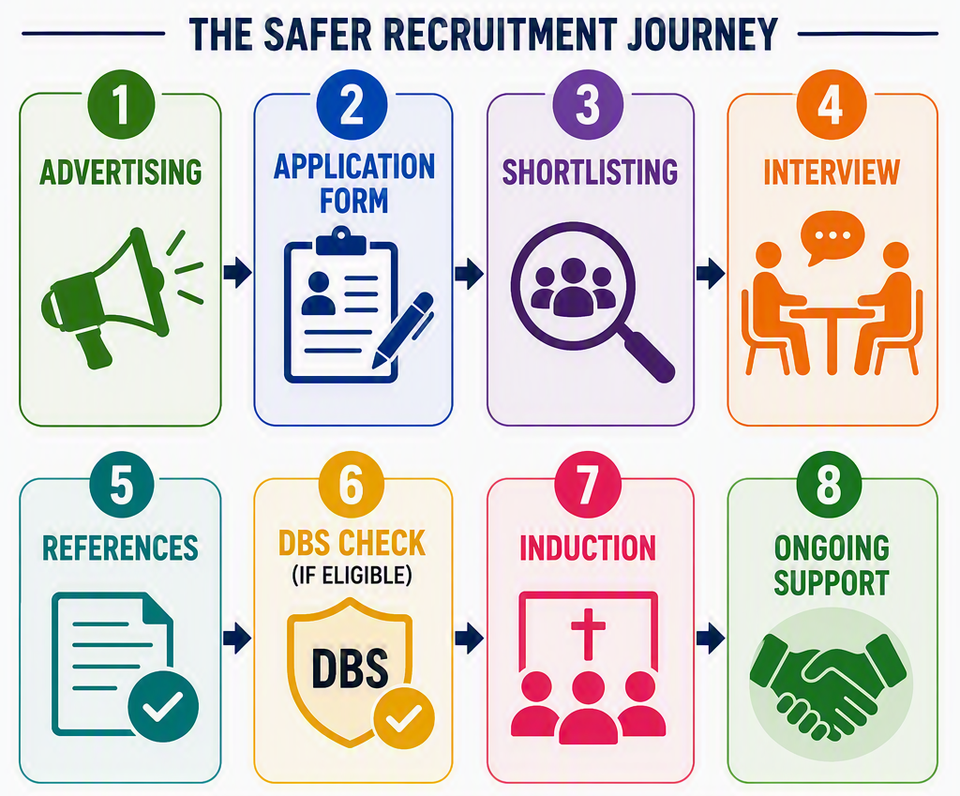
ADVERTISING
Detailed Guidance on Advertising
Advertisements and role notices must include (or clearly signpost):
- A commitment to safeguarding and safer recruitment.
- Key requirements from the person specification.
- Any required pre-appointment checks.
Personal invitations to volunteer
- Even where someone is approached directly, the same safer recruitment requirements still apply.
Role Description and Person Specification
- Every volunteer role must have a written role description and person specification.
- These should clearly outline the role, any safeguarding responsibilities, and the church's commitment to safeguarding children, young people, and vulnerable adults
Remember: Being keen to recruit volunteers is no reason to skip safer recruitment. Taking time to get the right people into the right roles helps create a safer church for everyone.
APPLICATION FORM
Detailed Guidance on Application Forms (including a template application form)
Before someone applies, provide:
- Safeguarding information and key policies (see detailed guidance)
- The role description and person specification.
- Information about the recruitment process.
- A privacy notice.
Application process
- Use an application form (not a CV).
- Collect contact details and any relevant qualifications.
- Ask applicants to explain why they are suitable for the role.
- Obtain a completed Confidential Declaration Form.
- Obtain referee details.
- Record any relevant work or volunteering with children, young people, or vulnerable adults.
- Ask the applicant to confirm that the information provided is true and complete.
Remember: An application form helps you gather the information needed to recruit volunteers safely, fairly and consistently.
SHORTLISTING
Detailed Guidance on Shortlisting
Even if there is only one person interested, or you are keen to fill the role, follow the same shortlisting process
- At least two people should be involved in shortlisting including the person responsible for recruiting to this role
- Only shortlist people who meet the essential requirements for the role.
- Use the application form and Confidential Declaration Form when making your decision.
- Look out for any gaps, missing information or concerns in the application.
- Make a note of anything you want to ask them about.
Remember: Being grateful for volunteers should never means skipping safer recruitment checks. Everyone should go through the same fair and safe process.
INTERVIEW
Detailed Guidance on Interviews
- Interview everyone you shortlist, even if there's only one applicant.
- Have at least two people involved in the interview.
- Make sure one of them has completed Safer Recruitment and People Management training within the last three years.
- Include someone who understands the role and can help decide whether the person is a good fit.
- Avoid interviewing family members or close friends. If this can't be avoided, involve an extra person and be open about the connection.
- Ask about safeguarding, as well as the person's skills, experience and approach to the role.
- Talk through any gaps, missing information or questions that came up during the application process.
- Keep a brief record of the interview and any explanations provided.
Remember: Even when you're delighted to have volunteers come forward, and even when there's only one applicant, don't skip the interview. It's an important part of making sure the right people are appointed safely and fairly.
REFERENCES
Detailed Guidance on References
- Get two written references before appointing a volunteer.
- Make sure referees are over 18 and are not relatives or family members.
- Don't accept references provided by the applicant themselves, generic testimonials, or verbal references.
- Make sure at least one referee is outside your church.
- Get a reference from someone who can comment on the applicant's suitability for the role and the people they will be working with.
- If the applicant currently works, or has worked in the last two years, with children, young people or vulnerable adults, get a reference from that organisation.
- If the applicant has moved from another church within the last two years, get a reference from that church.
Remember: References are an important part of safer recruitment and should always be obtained before an appointment is confirmed
INDUCTION
Detailed Guidance on Induction
- Complete required safeguarding training. See Training Requirements for Church Roles
- Know how to report a safeguarding concern.
- Meet with the person who will provide support in the role.
- Understand what the role involves and what is expected.
- Know where to get help, advice and support.
Remember: Give volunteers a warm welcome and make sure they have the information and support they need to carry out their role confidently and safely.
ONGOING SUPPORT
Detailed Guidance on Ongoing Support
Make sure every volunteer knows who they report to.
- Arrange regular catch-ups to provide support and discuss any safeguarding matters.
- Record and follow up any safeguarding concerns.
- Help volunteers continue to develop their safeguarding knowledge and confidence.
- If there are concerns about a volunteer's conduct or behaviour, follow the appropriate safeguarding procedures.
Remember: Good support helps volunteers feel valued, confident and safe in their role.